




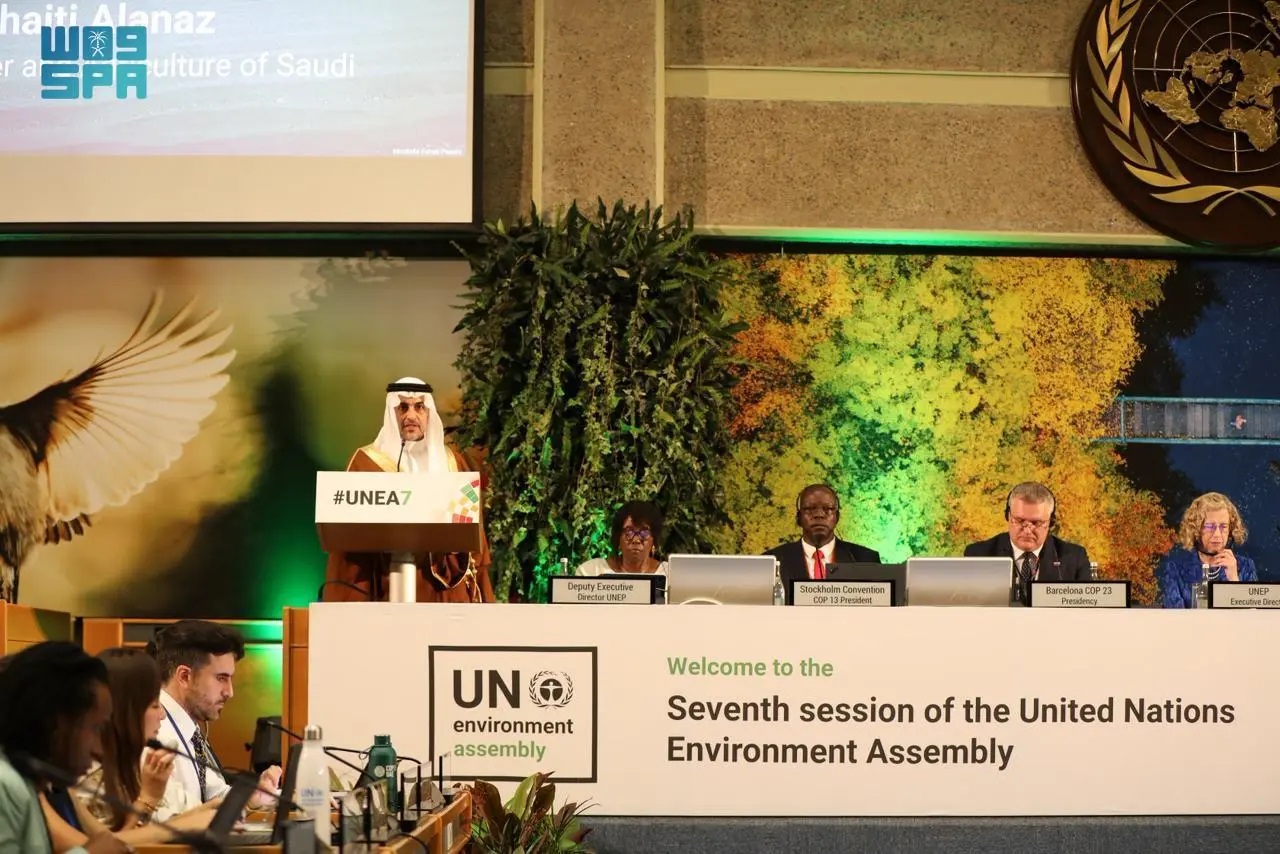
Saudi Arabia Showcases COP16 Presidency Achievements in Combating Drought, Desertification, and Land Degradation at UN Assembly
Vice Minister of Environment, Water and Agriculture Eng. Mansour Hilal Almushaiti affirmed that the Kingdom plays an active role in major multilateral environmental agreements and exerts significant efforts to strengthen these agreements and bolster international cooperation to confront global environmental challenges, while achieving balance between development and environmental protection for the prosperity of nations and the resilience of the planet.
This came during his remarks today, delivered in his capacity as COP16 President, at the seventh session of the UN Environment Assembly held in Nairobi, Kenya.
According to a press release issued by the ministry today, Eng. Almushaiti reviewed the key outcomes of the sixteenth Conference of the Parties to the United Nations Convention to Combat Desertification (COP16), which the Kingdom hosted in December 2024 with broad international participation.
Eng. Almushaiti explained that the Kingdom is advancing environmental action at the national, regional, and international levels through the National Environment Strategy, the Saudi Green Initiative, the Middle East Green Initiative, and other efforts undertaken to address global challenges. He highlighted the conference outcomes that strengthened international cooperation to reduce land degradation, given its profound impact on water and food security, biodiversity, and societal well-being, noting that more than three billion people worldwide are affected by land degradation.
He added that the conference adopted 37 resolutions covering several important areas to enhance progress toward the convention’s objectives. These include resolutions supporting the preservation and sustainable management of agricultural lands, strengthening the conservation of rangelands due to their significant environmental and social value, encouraging joint cooperation to advance knowledge-building through research and innovation, and supporting local communities, women, youth, civil society organizations, and financing mechanisms.
The vice environment minister stated that the conference also produced a number of impactful outcomes that further reinforced international action. The release added that the implementation dimension of the convention was strengthened through the launch of the Riyadh Action Agenda, which includes nearly 40 initiatives aimed at reducing land degradation and the effects of drought. Foremost among them is the Riyadh Global Drought Preparedness Partnership, which seeks to enhance the resilience of the most vulnerable developing countries by adopting a proactive approach to drought mitigation, especially as drought currently affects about one-quarter of the world’s population. He noted that significant progress was also achieved in negotiations related to the drought framework, reaffirming the Kingdom’s commitment to supporting continued dialogue among regions on this important track.
He further pointed to efforts to strengthen private-sector engagement in land conservation and restoration through the launch of the Business for Land initiative, implemented in cooperation with the Convention’s Secretariat and various stakeholders. The initiative aims to encourage the global private sector to adopt comprehensive goals and action plans that enable it to continue contributing to economic growth while enhancing efforts to preserve land and minimize degradation. He also underscored the importance of holistic international cooperation across all multilateral environmental agreements and the need to support and integrate them through appropriate financing mechanisms that facilitate access to funding at levels sufficient to achieve their objectives.
In conclusion, Eng. Almushaiti stressed the importance of integrating the goals of these agreements into countries’ national frameworks and development plans, in addition to enhancing knowledge transfer and capacity building for developing nations, and strengthening coordination among the secretariats of these agreements to maximize the benefits of their collective implementation, contributing to the sustainability of the planet’s environment for future generations.


