
Philips Future Health Index 2026: Saudi Arabia consistently ranking above global averages in benefits cited from using AI in healthcare
Philips Future Health Index 2026: Saudi Arabia consistently ranking above global averages in benefits cited from using AI in healthcare.
•Almost all clinicians in Saudi Arabia (99.5%) are either saving time or are seeing benefits using AI, which is notably higher than the global average of 91%.
•80% of clinicians say AI has increased their capacity to see more patients, while 86% of clinicians report improved workflow efficiency.
•96% of clinicians say their role is already becoming more focussed on higher-value clinical work or will in the future.
•81% of clinicians say AI has improved their work-life balance.
Nearly every clinician in Saudi Arabia (99.5%) is already saving time or seeing tangible benefits from AI, according to Future Health Index (FHI) 2026 for the Kingdom of Saudi Arabia, the 11th edition of the global report, based on perspectives from over 2,000 healthcare professionals and 20,000 patients across 10 countries.
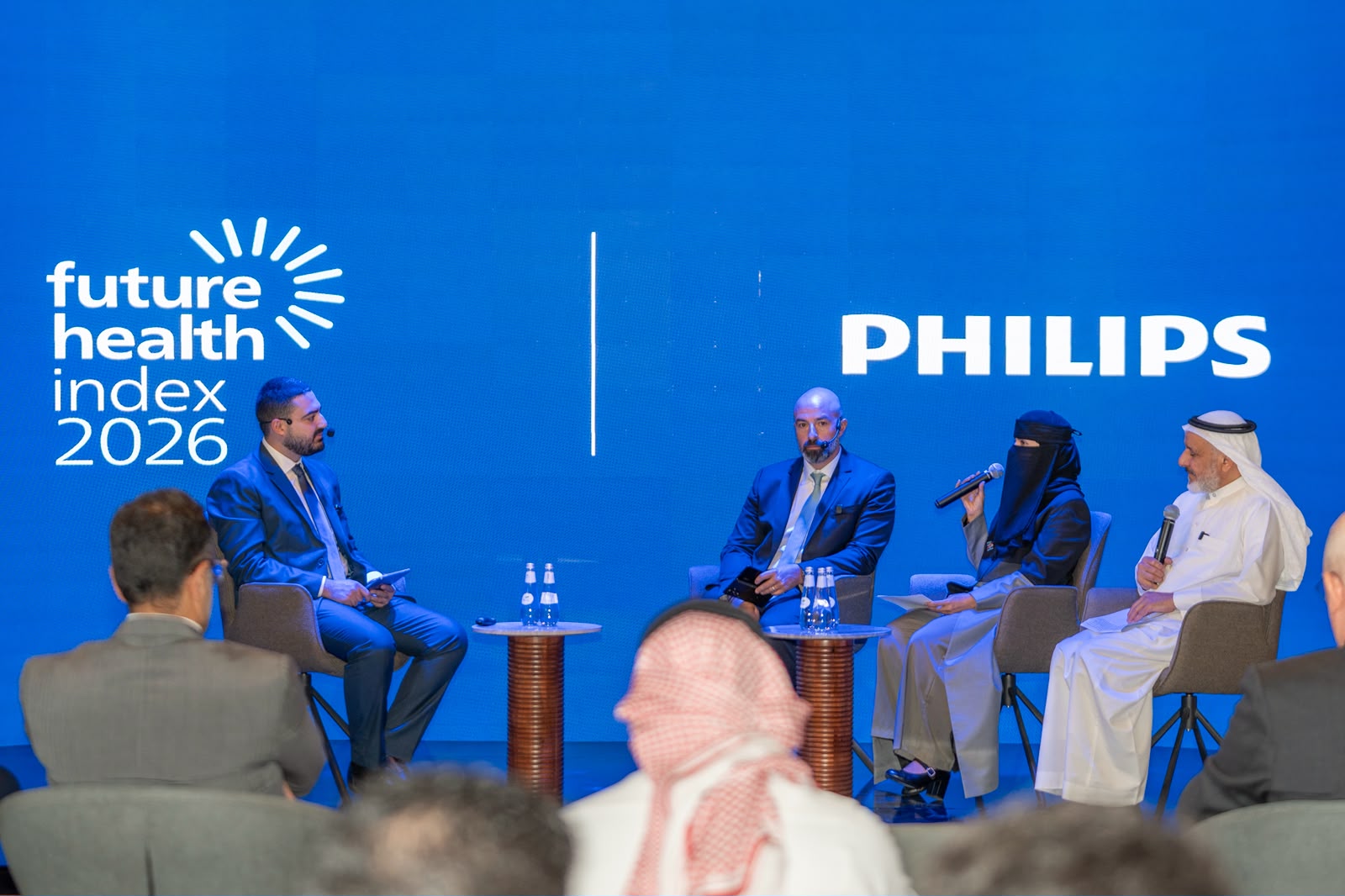
The report was released today at an event in Riyadh attended by H.E Hans Peter van der Woude, Ambassador of the Kingdom of the Netherlands to Saudi Arabia, Dr. Fahad Alkhodairy Senior Medical Scientist, and Dr. Fouziyah Aljarallah CEO of Hayat National Hospitals, hosted by Marc Zora, CEO, Philips Middle East, Türkiye & Africa - reflecting the significance of these findings as a benchmark for AI-enabled healthcare transformation.
The findings land against the backdrop of Saudi’s Healthcare Transformation under Vision 2030, which continues to expand the Kingdom’s healthcare capacity with a shift toward value-based, integrated care.
“Saudi Arabia is leading the shift from AI promise to progress in healthcare, setting the pace for the region and standing out globally for its rapid adoption and integration of AI,” says Zora. “For Philips, innovation has never been measured by adoption alone. This report gives us real evidence of the impact, with AI already part of everyday care delivery across the Kingdom, helping clinicians make better use of time, information and expertise to better support patient care.”
Better Decisions, Faster
According to the FHI 2026 Saudi Arabia findings, nine in 10 healthcare professionals (90%) believe the benefits already outweigh the risks, and they’re optimistic that AI can improve patient outcomes (89%) - up 10 percentage points from a year earlier.
The payoff many have been working toward is starting to come into view. Of all countries surveyed, Saudi Arabia ranked highest in AI enabling increased consolidation of patient data (92%), improving quality of time spent with patients during interactions (89%) and increasing capacity to see additional patients during a typical workday (80%).
In Saudi Arabia, leadership is capitalizing on strong momentum to accelerate AI adoption and building the necessary supporting infrastructure. The vast majority of clinicians (88%) say their organization’s leadership is taking the right steps to implement AI-enabled tools, which ranks highest among all countries surveyed.
“These gains signal the deeper promise of AI in Saudi healthcare: faster, more human care that is timely, coordinated and truly personalized,” says Zora.
Where healthcare organizations in Saudi Arabia are using AI, clinicians report measurable improvements in care. Healthcare professionals report that AI is freeing up time, strengthening clinical decision-making, expanding capacity and delivering operational and financial benefits - creating growing ‘AI dividends’ across patient care and core clinical work.
AI is giving clinicians time and improving well-being
By reducing the administrative burden and supporting more efficient workflows, AI-enabled tools are streamlining routine tasks. Clinicians say AI saves them time every week with as many as 42% reporting time savings of at least 132 hours annually on average, or the equivalent of more than three full working weeks .
Rather than just freeing up time, AI is shifting how clinicians work. Clinicians in Saudi Arabia saving time using AI rank highest among the countries for reinvesting their saved time into training other healthcare professionals (92%), collaborating across care teams (88%) and working on their professional development (88%).
“Value isn’t only measured in hours or clinical capacity, but also in reduced cognitive load, less stress and better work-life balance that reflect the broader Vision 2030 well-being agenda for a healthier, longer-living population,” says Zora.
More thorough patient interactions, and safer care
Eight in 10 clinicians say AI has increased their capacity to see more patients, with a median increase of seven additional patients per week.
But it’s not just more access: AI is impacting the quality of care by improving patient safety in Saudi Arabia. More than half of healthcare professionals say it has helped them identify or prevent a potential medical error at least three times in the past three months, and 86% saving time using AI say it is leading to more thorough interactions with their patients. In fact, 81% of clinicians say AI-empowered patients will be an integral part of care teams in the future.
Among patients using generative AI for health information, 86% say it saves them time - helping them find information, prepare for appointments or understand a diagnosis - and 68% say it has helped them recognize when seeing a doctor is necessary.
The next era of care
The FHI 2026 Saudi Arabia findings show that healthcare professionals overwhelmingly believe that human judgment, accountability and relationships remain central to care – and to maintaining trust with their patients. The majority of clinicians in Saudi Arabia (85%) say AI will never replace the relationships clinicians build with patients, while 83% believe human interaction skills will become even more important as AI advances. Clinicians could have more space to focus on the moments in care where their expertise has the greatest impact.
As AI in healthcare is entering its next phase, the opportunity isn’t to add new tools, but to reshape how care is delivered around a new hybrid care team. In Saudi Arabia, strong governance and training that keeps pace with adoption can help the Kingdom’s care teams move further toward coordinated, proactive and personalized care, where clinicians and empowered patients work together.
“The next priority is to move from AI in practice to AI at scale, where health systems, technology partners and regulators work together to integrating it responsibly into the hybrid care team, while deliberately protecting and reinvesting time in clinical care, so that we can deliver better care for more people, together,” says Zora.
See how AI is reshaping health in Saudi Arabia – download the full Philips Future Health Index 2026 report for Saudi Arabia at http://www.philips.sa/futurehealthindex-2026.