




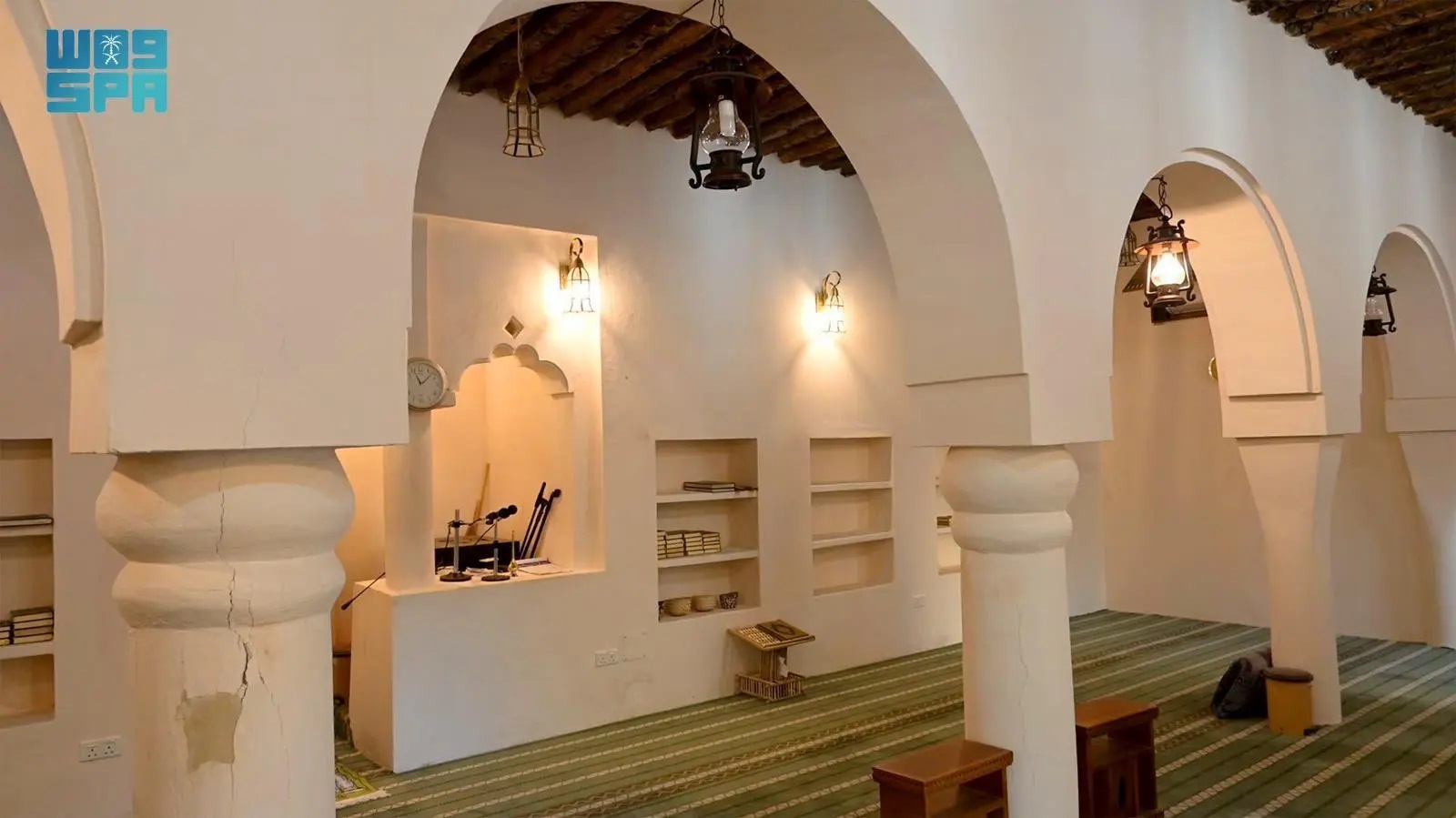
Prince Mohammed bin Salman Project Develops Sheikh Abu Bakr Mosque in Al-Hofuf
The Prince Mohammed bin Salman Project for the Development of Historical Mosques continues to restore and rehabilitate historic mosques across the Kingdom, preserving their authentic architecture and enhancing their centuries-old religious and scholarly significance, as exemplified by Sheikh Abu Bakr Mosque in Al-Hofuf, in line with the objectives of Saudi Vision 2030.
The mosque is located in the heart of the historic Al-Koot neighborhood in Al-Hofuf, Al-Ahsa Governorate, Eastern Region, about 200 meters east of Al-Koot Cemetery and roughly 390 meters southwest of Ibrahim Palace. Its location is notable for its proximity to the house of Sheikh Abu Bakr and his religious schools, which hosted circles for teaching Islamic sciences and Arabic, reflecting the mosque’s close connection to the region’s scholarly movement.
The mosque is also known as Sheikh Mohammed bin Abi Bakr Al-Mulla Mosque or the Eastern Mosque, and its history dates back about three centuries, making it one of the oldest heritage mosques in Al-Ahsa. Since its establishment, its role has not been limited to performing prayers; it also served as a scholarly beacon, hosting lessons in jurisprudence, interpretation, and grammar, as well as teaching and memorizing the Holy Quran, before later focusing primarily on Quran memorization.
Sheikh Abu Bakr Mosque features a traditional architectural style reflecting the environment of Al-Ahsa, built using mud, gravel, and palm trunks in a form that embodies the simplicity of local architecture and its adaptation to the climate. The mosque originally covered about 565 square meters, and after rehabilitation it now accommodates approximately 125 worshippers.
Sheikh Abu Bakr Mosque stands as a testament to a rich scholarly and spiritual history and underscores the importance of preserving such landmarks as part of Al-Ahsa’s cultural and religious identity, ensuring their legacy for future generations.
Its recent development marks a key step in national efforts to protect historic mosques, strengthening their role and reinforcing their value for the community and generations to come.


