




Zamzam Well: Symbol of Divine Mercy, Sanctuary for Pilgrims and Worshippers, Cherished by Muslims Worldwide
Zamzam Well, regarded as the most famous well on earth, stands as one of the most significant landmarks of the Grand Mosque to which the hearts of Muslims are deeply attached.
It is located within the Mataf area of the Grand Mosque, with a depth extending to 30 meters –12.80 meters built, and 17.20 meters carved into the mountain rock. Its diameter varies according to depth, ranging between 1.5 and 2.5 meters.
The history of Zamzam Well dates back to the time of the Prophet Ismail, when Prophet Ibrahim left his wife Hagar and their son Ismail in a barren valley without vegetation or water.
As Hagar ran between Safa and Marwa in search of water for her infant, the Angel Gabriel struck the ground with his heel, and the blessed waters of Zamzam gushed forth. She contained the flow and filled her vessel from it. Since then, the well has become a symbol of divine mercy and a sanctuary for pilgrims and worshippers performing Hajj and Umrah.
Over the centuries, Zamzam Well has witnessed continuous care and maintenance. In 1373 AH, late King Abdulaziz bin Abdulrahman Al Saud modernized the well by installing advanced pumps and connecting each reservoir to 12 taps distributed around the well, which greatly facilitated the extraction of water.
In 1382 AH, during the reign of late King Saud the buildings surrounding Zamzam Well were removed to expand the Mataf.
The well was then relocated to a basement beneath the Mataf, marking the end of the era of buckets and their replacement with taps. Later, in 1399 AH, late King Khalid ordered the cleaning of Zamzam Well using the most advanced methods and carried out by experienced divers. This operation was among the greatest cleaning efforts in the history of Zamzam Well, resulting in the well overflowing with water in abundance far greater than before.
In 1424 AH, during the reign of late King Fahd, studies concerning the Grand Mosque recommended covering Zamzam Well. Its entrances were sealed to provide greater space for tawaf (circumambulation) and prayer.
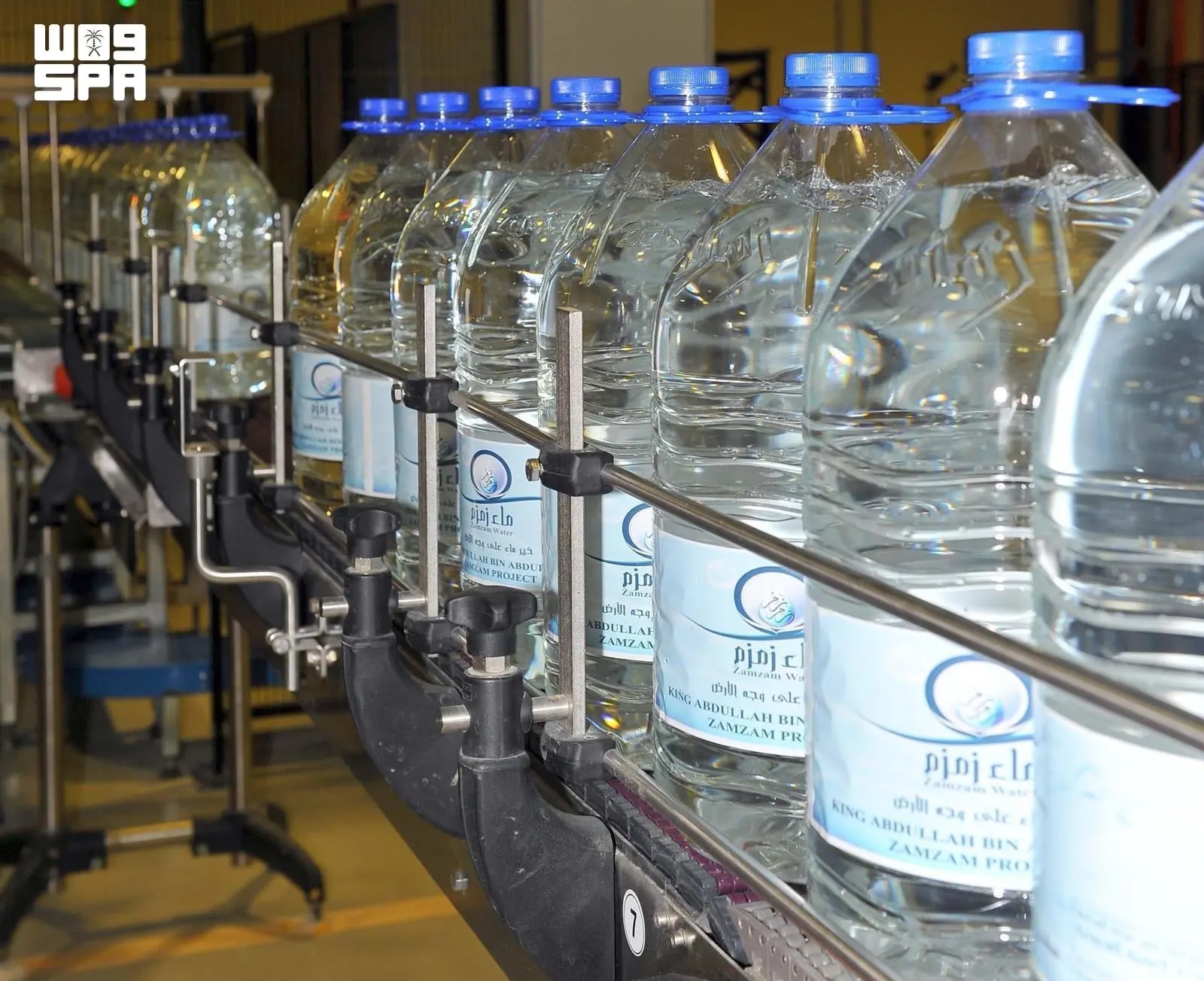
Later, in the reign of late King Abdullah, an order was issued to establish a water purification station for the well, along with a plant and factory for bottling and distribution, operating under an automated system of control, monitoring, and storage.
In the era of Custodian of the Two Holy Mosques King Salman bin Abdulaziz Al Saud, the Custodian of the Two Holy Mosques directed the resumption of projects related to Zamzam Well, completing the final stage of sterilization, removal of impurities, and examination of the surrounding environment.
The journey of Zamzam water to the visitors of the Grand Mosque and the Prophet’s Mosque passes through several stages, including purification and sterilization, as raw water is pumped from the well by two giant pumps through transmission lines made of stainless steel.


