




Finance Minister: Saudi Arabia’s 2027 Budget Prioritizes Essential Services and Economic Growth
Minister of Finance Mohammed Aljadaan affirmed that the priorities of the State General Budget for the upcoming fiscal year 1448/1449 AH (2027) include continuing to provide essential services to citizens, improving their quality of life, and directing support to eligible groups. The budget also prioritizes supporting the private sector, promoting economic growth, and preserving the Kingdom’s national achievements. He noted that projected revenues for the coming year amount to SAR1.202 trillion, with estimated expenditures of SAR1.392 trillion, resulting in a projected deficit of approximately SAR190 billion.
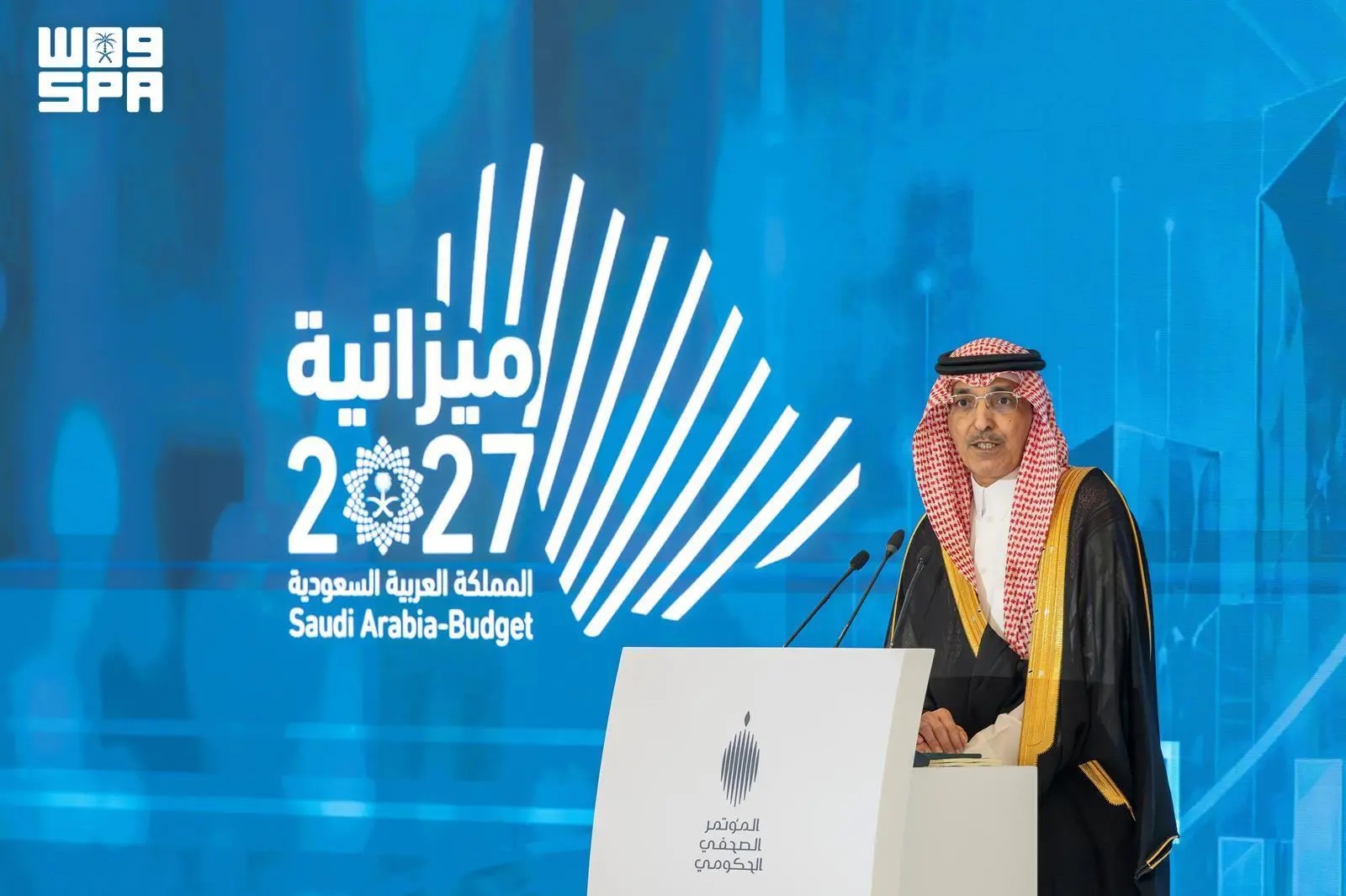
His remarks came during a government press conference organized by the Ministry of Media in Riyadh today, following the approval of the State General Budget for fiscal year 2027. He highlighted key aspects of fiscal and economic performance in 2026, details of the 2027 budget, public finances over the medium term, expenditure allocations across sectors, and prospects for economic growth.
Aljadaan explained that over the past ten years, following the launch of Saudi Vision 2030, the Kingdom has undergone a profound economic and developmental transformation. Non-oil activities have expanded, the private sector’s contribution to the economy has increased, and services provided to citizens have improved, even as economies worldwide faced successive challenges.
He noted that Saudi Vision 2030 was introduced to restructure the economy and public finances, diversify the economic base and sources of non-oil revenues, support the private sector, and strengthen the Saudi economy’s resilience to external shocks.
He said estimates indicate that fiscal year 2026 will close with expenditures of approximately SAR1.436 trillion, revenues of SAR1.191 trillion, and a deficit of SAR245 billion, representing about 4.9% of gross domestic product (GDP). He reaffirmed the government’s ability to keep deficit levels under control despite existing challenges.
Aljadaan emphasized that despite a 2.1% decline in GDP due to lower oil production volumes, non-oil GDP maintained positive growth. Its share of total GDP rose to 57.7%, the highest level recorded in the Kingdom’s history since data collection began.
The minister noted that this transformation reflects the diversification of the Saudi economy, with sectors such as technology, tourism, industry, and military industries actively contributing to economic activity. All these sectors have experienced significant growth in recent years.
He affirmed that indicators of domestic economic activity reflect the economy’s resilience, with domestic demand continuing to grow despite challenges. Employment of Saudi nationals in the private sector increased by 7% compared with the previous year, while profits of companies listed on the capital market grew by 17% through the third quarter compared with the previous year.
He added that the Purchasing Managers’ Index (PMI) reached 54 points in October, surpassing the averages of the G20 and Gulf Cooperation Council (GCC) countries. The number of micro, small, and medium-sized enterprises (MSMEs) also increased by 4% between the end of 2025 and the second quarter of 2026, reaching 1.832 million establishments. This growth reflects the opportunities that investors and entrepreneurs see in the Saudi economy.
Regarding public finance and banking sector indicators, the finance minister said the government had maintained its deposits with the Saudi Central Bank (SAMA) at SAR399 billion. He noted that SAMA’s foreign reserve assets stood at SAR1.7 trillion at the end of the first half of this year, while bank credit grew by around 7%. Non-performing loans remained stable at below 1%, one of the lowest levels globally, he added.
The minister indicated that inflation had remained stable and was expected to reach 1.8% this year, despite the International Monetary Fund (IMF) raising its global inflation forecast for 2026 from 4.1% to 4.7%. He attributed the stability of domestic inflation to the government’s proactive interventions.
Aljadaan also reviewed the growth of non-oil activities this year, saying they grew by 2.8% in the first quarter before being affected by the repercussions of the geopolitical crisis and the near-total closure of ports in the eastern part of the Kingdom. He said growth resumed in the third quarter following the rerouting of imports and exports to western ports. He expects non-oil GDP to grow by 2.5% by the end of this year.
Aljadaan revealed that Saudi Arabia had implemented more than 200 measures since the beginning of the crisis, including policies, procedures, regulations, and financing measures, as well as financing facilities provided by national development funds to borrowers and businesses. These measures aimed to provide the liquidity needed for working capital, imports of food and essential commodities, and production inputs, he noted.
The minister said the Royal Order to reactivate the Unemployment Insurance (SANED) program for sectors affected by the crisis for three months, subject to extension, was intended to preserve contractual relationships between employees and employers and prevent their termination due to temporary challenges. He added that a ministerial committee had been formed to respond flexibly and swiftly to the needs of business sectors, including requests for exemptions.
He indicated that, for the first time in the Kingdom, the government had established an insurance pool in cooperation with the Insurance Authority and national insurance companies to help reduce insurance costs for shipments arriving at the Kingdom’s ports. This had contributed to a reduction in insurance costs of approximately 50% to 60%, with the impact expected to become evident gradually as new insurance policies are issued, he said.
Aljadaan also highlighted government efforts to facilitate the movement of imports into Saudi Arabia and other Gulf Cooperation Council (GCC) countries through Red Sea ports. These efforts include streamlining customs procedures, facilitating the entry and exit of trucks at ports, expediting inspections, and strengthening coordination mechanisms among the countries.
Regarding expenditure allocations in the 2027 budget, the finance minister said approximately SAR544 billion would be allocated to the education, health, social development, and municipal services sectors. Estimated spending on the military sector would reach SAR263 billion, an increase of around SAR9 billion compared with the expected expenditure for the current year.
He indicated that the medium-term fiscal estimates for 2028 and 2029 aim to provide the economy and the private sector with a clear outlook on the budget’s direction and government spending trends.
The minister projected that gross domestic product (GDP) would grow by 10% in 2027, compared with an estimate of 12% in the Pre-Budget Statement. He explained that the revision reflected higher oil production during the final three months of this year, which raised the comparison base. He added that the projected growth would be driven mainly by increased oil production and continued growth in non-oil GDP.
Aljadaan also said nominal GDP is expected to reach approximately SAR5.364 trillion by the end of this year, while inflation is projected to reach 2.3% next year.
He stated that Saudi Vision 2030 was more than a project, initiative, or strategy. It represented an ongoing structural transformation of the social, economic, and financial landscape that would maintain its momentum despite challenges.
He stressed that the government’s priorities were to safeguard the country and its achievements, provide citizens with essential services, give the private sector a clear outlook on government policies and support, and continue developing the basic infrastructure underpinning the economy.
Saudi Arabia’s economy has demonstrated a strong ability to withstand successive global crises over the past decades, overcoming economic and geopolitical shocks and emerging stronger and more resilient, the minister said. He noted that the positive results achieved in 2026 and the reasonable forecasts for 2027 reflect the strength and stability of Saudi Arabia’s economic foundation.
Aljadaan said official figures issued by independent entities showed continued growth in private-sector investment through the third quarter of 2026, at a faster pace than in the previous year, alongside rising consumption levels. He stressed that this growth reflects the confidence of domestic and private investors in the Saudi economy, independent of government spending or investments by the Public Investment Fund (PIF). This, he said, makes the growth targets set in the budget realistic and achievable.
The minister noted that the government’s fiscal policy follows a conservative and disciplined approach to preparing annual budget estimates, with forecasts based on realistic assumptions rather than exaggeration or excessive optimism. This approach has resulted in actual revenues exceeding the budget’s announced estimates in recent years.
Aljadaan also pointed to rising levels of sovereign debt as one of the most prominent risks facing the global economy today. The issue featured prominently in discussions at the annual meetings of the IMF and the World Bank, particularly as debt in some countries has exceeded 100% of GDP.
He affirmed that Saudi Arabia enjoys a strong fiscal position, with safe and healthy debt levels relative to GDP. He added that the ratio of debt-servicing costs to total revenue remains within acceptable ranges, while the economic returns from borrowing have been positive and outweigh its costs.
Addressing the impact of rising global interest rates on Saudi Arabia’s public debt portfolio, the minister noted that between 89% and 90% of government debt carries fixed rather than variable interest rates. More than half of the portfolio was borrowed at rates below 3%. He stressed that there is no cause for concern over the medium term, citing the efficient management of the portfolio by the National Debt Management Center (NDMC) and the high level of professionalism demonstrated by its young Saudi professionals.
Regarding the transition from the Privatization Program to the National Privatization Strategy, the minister explained that the former had served as a foundational program and concluded its work with the preparation of the new strategy, which he described as ambitious.
He noted that around 200 privatization contracts had been signed since 2017, with a combined value of approximately SAR800 billion. These included asset sales and public-private partnerships, helping support the private sector and improve the efficiency of government projects during both the construction and operational phases.
Aljadaan said privatization efforts are continuing, with around 202 projects at various stages of tendering, bid submission, and proposal evaluation. The projects cover the water, electricity, healthcare, environment, transportation, and real estate sectors, among others.


