




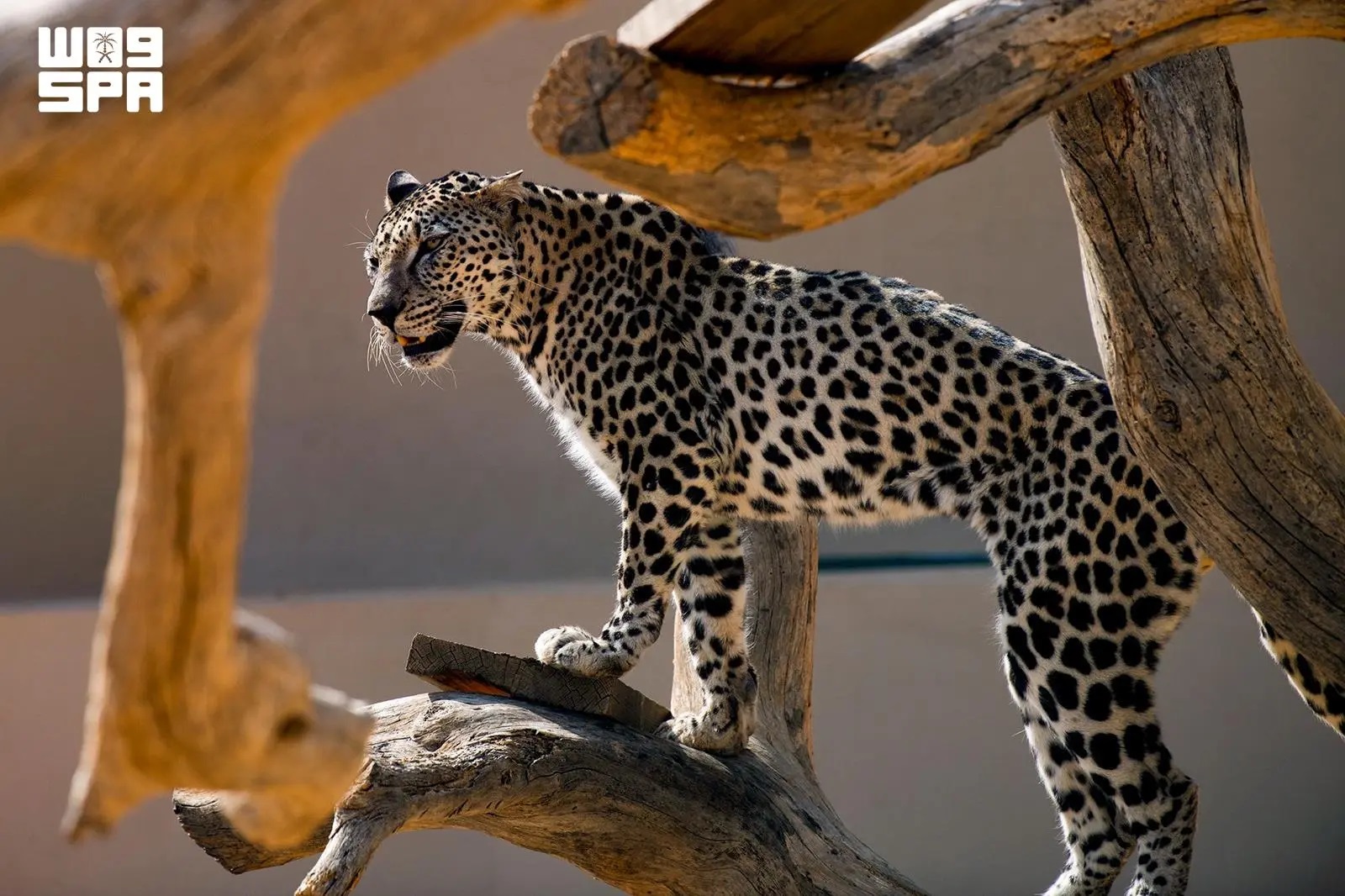
From Taif to AlUla: Saudi Arabia’s Efforts to Protect the Arabian Leopard
Efforts to save the Arabian leopard in Saudi Arabia have extended far beyond protecting a rare species. Over three decades, conservation efforts have focused on safeguarding the animal, improving its chances of survival, and preparing for its eventual return to its natural habitat. What began with research and breeding programs in Taif has since expanded under the Royal Commission for AlUla (RCU) to include increasing the leopard population and restoring its natural habitats in preparation for its reintroduction into the wild.
The Arabian leopard once roamed the mountainous highlands of Saudi Arabia’s western and southern regions, inhabiting rocky slopes and rugged wadis and adapting to the challenging terrain. As an apex predator, it played an important role in regulating prey populations and maintaining ecological balance. However, decades of mounting pressures, including overhunting, declining prey populations, habitat degradation, and expanding human activity, have severely reduced its presence in the wild. The species is now classified as critically endangered.
Taif marked a turning point in the Kingdom’s conservation efforts with the move toward a structured, institutional approach. In 1416 AH, a decision was issued to establish a national committee for Arabian leopard conservation, alongside a breeding program at the National Center for Wildlife Research, later renamed the Prince Saud Al-Faisal Center for Wildlife Research. Taif subsequently became a scientific hub for efforts to ensure the survival of the rare species under human care.
The center’s work included providing a secure environment for the leopards, monitoring their behavior, reproduction, and health, advancing veterinary care, and managing genetic diversity. These efforts aimed to establish self-sustaining breeding populations and secure the species’ long-term survival.
In December 2020, responsibility for the Arabian leopard breeding program and management of its breeding center was transferred from the National Center for Wildlife to RCU. This marked the beginning of a broader conservation phase based on an integrated approach combining captive breeding, scientific research, ecosystem restoration, threat mitigation, and the development of specialized expertise. The Arabian Leopard Fund also supports these efforts through partnerships and initiatives aimed at protecting the species and building conservation capacity.
Breeding programs managed by RCU at the Arabian Leopard Breeding and Conservation Center in Taif have made notable progress. The population under human care has more than doubled since the commission assumed responsibility for the program, with several successful births recorded in recent years.
In January 2025, the center received accreditation from the European Association of Zoos and Aquaria (EAZA), becoming the first institution of its kind in the Kingdom to receive this recognition. The accreditation reflects progress in specialized animal care and management and creates further opportunities for cooperation and the exchange of expertise with international organizations working to protect endangered species.
RCU has also strengthened scientific cooperation with the Smithsonian Institution and its National Zoo and Conservation Biology Institute. The partnership supports research, genetic diversity management, conservation breeding, and the exchange of knowledge and expertise. In September 2026, the foundation stone was laid in Washington, D.C., for a habitat dedicated to the Arabian leopard, marking another step toward raising international awareness of the endangered species.
From the early scientific efforts in Taif to ecosystem restoration initiatives in AlUla, the return of the Arabian leopard to the wild remains a long-term objective. Achieving this goal will depend on the readiness of natural habitats, the recovery of prey populations, genetic suitability, and animal welfare requirements, all of which remain subject to ongoing scientific assessment.


