




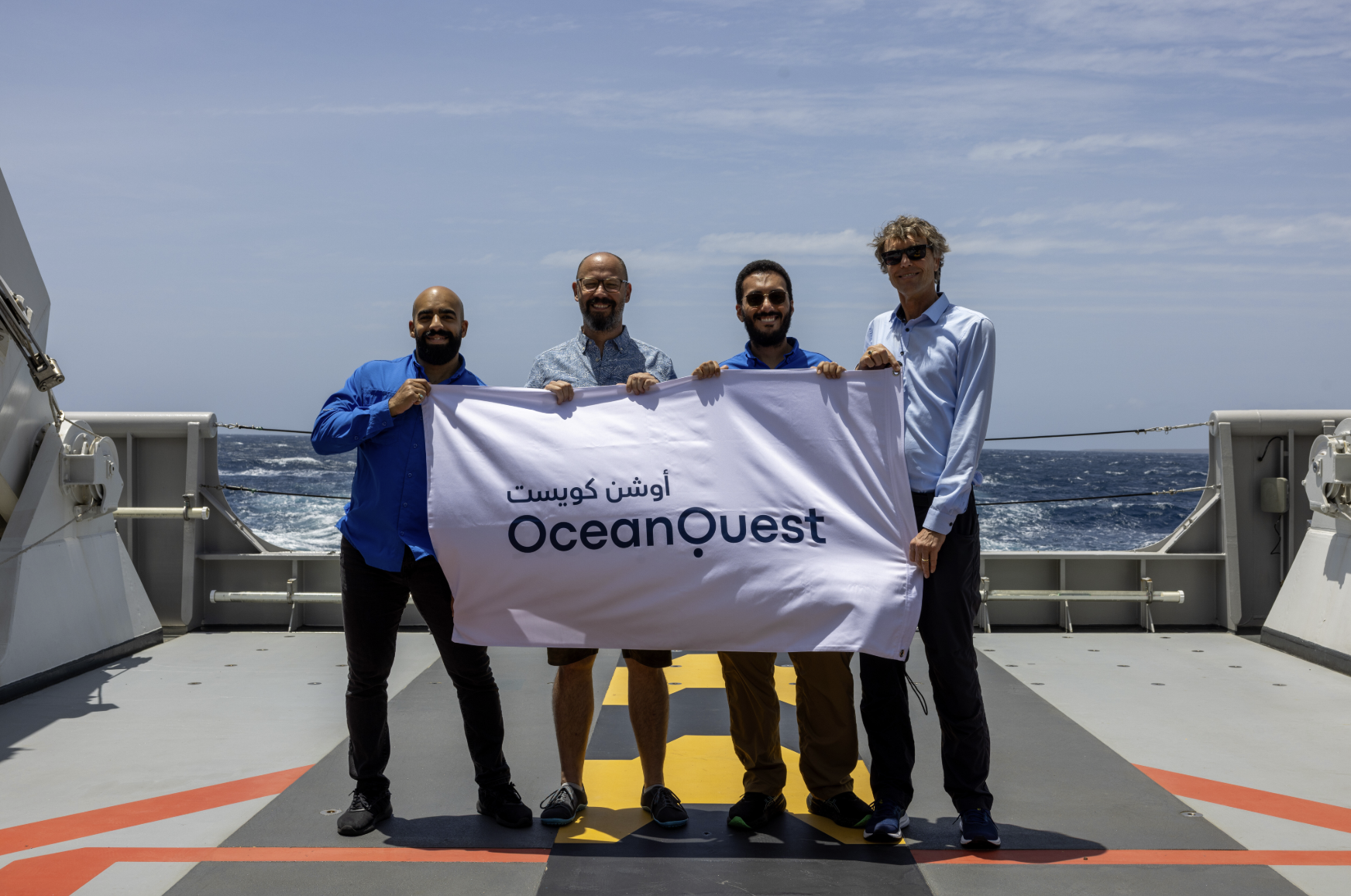
OceanQuest: A Saudi Foundation Charting New Depths in Ocean Exploration and Sustainability
In this exclusive interview, we speak with Dr. Martin Visbeck, Chief Executive Officer of OceanQuest, the Saudi nonprofit foundation dedicated to advancing deep-ocean exploration, scientific innovation, and global collaboration. Dr. Visbeck shares insights into OceanQuest’s mission, its alignment with Saudi Arabia’s Vision 2030, and how the foundation is charting new depths in understanding some of the planet’s most mysterious and vital ecosystems.
1- What inspired the creation of OceanQuest as a Saudi not-for-profit foundation, and how does it contribute to Vision 2030’s goals in science, sustainability, and innovation?
- OceanQuest was founded with a simple but powerful belief, that understanding the deep ocean is essential to understanding our planet, and that Saudi Arabia is contributing in a major way to shaping this new frontier of exploration.
As a Saudi not-for-profit foundation, OceanQuest reflects the ambition of Vision 2030:, fostering innovation, empowering human capability and advancing sustainability. The Kingdom has already demonstrated remarkable leadership in clean energy, technology, and environmental stewardship, and deep ocean discovery embodies this same spirit of leadership and innovation that defines Vision 2030.
OceanQuest’s mission is to accelerate ocean discovery, drive innovation in the field, support global cooperation, and excite the public. By cultivating partnerships that advance multidisciplinary ocean research, the foundation aims to benefit humanity, enhance ocean literacy, and elevate public awareness.
OceanQuest will support Saudi Arabia’s Vision 2030 ambitions by spearheading innovation in ocean exploration, nurturing global partnerships, and providing critical ocean knowledge to advance sustainable development. The foundation is set to contribute to the Kingdom’s national research, development, and innovation (RDI) targets by providing SAR3 billion in research and development funding by 2050 and aiming to support more than 100 scientists annually through its global network of partnerships and deep ocean expedition programs. In addition, OceanQuest will help achieve the Kingdom’s goal of protecting 30% of its marine habitats with a focus on the deep ocean, identifying sensitive marine ecosystems, enabling sustainable projects along the Red Sea. The foundation will explore deep ocean biotech opportunities and explore if deep-sea corals can be natural carbon sinks to support Saudi Arabia’s decarbonization efforts.
2- The Red Sea seems to play a central role in OceanQuest’s mission. What makes it so unique scientifically, and what are your upcoming plans to explore it?
The Red Sea is one of the most scientifically intriguing marine environments on Earth. Its waters are exceptionally warm, salty, and deep, a rare combination that has led to ecosystems uniquely adapted to these conditions. Studying these systems helps us understand how life evolves under environmental stress, offering valuable insights into how global oceans may respond to a warming climate.
For OceanQuest, the Red Sea is both a scientific frontier and a national priority. In collaboration with KAUST and other partners, we are preparing our first major Red Sea Expedition. Large parts of the Red Sea remain poorly mapped and poorly understood, and our mission is to help close this knowledge gap. The mission will focus on better understand and documenting deep-sea ecosystems, collecting high-resolution environmental data, and developing digital models of biodiversity and ocean circulation.
These efforts will strengthen Saudi Arabia’s scientific leadership by advancing the knowledge needed to understand one of the world’s most complex ocean systems. By advancing national expertise, training young Saudi scientists, and creating open-access scientific data, OceanQuest helps position the Kingdom as a global hub for ocean research and deep-sea exploration.
3- Seamounts are described as one of your main research focuses. Why are these underwater mountains so important, and what can they teach us about climate stability and marine biodiversity?
Seamounts, the undersea mostly dormant volcanoes that make up about 5% of the deep ocean only but play a critically important role in the broader ocean system. Seamounts are oases of life in the deep sea and keys to climate regulation, carbon cycling, and hold potential for pharmaceutical discovery.
Beyond their ecological importance, seamounts influence ocean currents, nutrient cycles, and carbon storage, making them essential to understanding how the ocean regulates Earth’s climate. Yet, despite their significance, over 80% of the world’s seamounts remain unstudied.
OceanQuest is investing heavily in this field, using deep-sea robotics, AI-assisted mapping, and digital twins to explore these structures safely and efficiently. Through our international partnerships, such as those with research institutions in South Africa, Brazil and other national or philanthropic ocean research organizations, we’re building a shared scientific base that will help guide global marine protection efforts.
Our aim is not only to discover but also provide key knowledge for protection, ensuring that these remarkable ecosystems are studied responsibly and conserved for future generations.
4- OceanQuest is introducing advanced tools like AI, robotics, and digital twins. How are these technologies changing the way we understand the deep ocean?
Innovation and Technology is at the heart of OceanQuest’s mission. For centuries, the deep ocean has been out of reach, vast, dark, and dangerous. But today, with autonomous vehicles, remotely operated robots and with the help of AI and digital twin technologies, we can explore these environments like never before.
At OceanQuest, we’re developing digital twins, highly detailed virtual models of specific ocean regions that integrate real-time data from sensors, robots, and satellites. These tools allow scientists to simulate ocean dynamics, predict environmental changes, and visualize interactions between species and habitats.
This kind of technology not only accelerates discovery but also democratizes science, allowing researchers from around the world, including those without access to vessels, to study and contribute to deep-ocean research. It’s a clear example of how Saudi Arabia’s investment in advanced technology and innovation can help drive global progress in ocean science.
5- You’ve emphasized training Saudi youth and professionals through programs like ECOPs. How do you see local talent shaping the future of ocean science in Saudi Arabia?
Empowering the next generation is at the heart of what we do. Through the support of Early Career Ocean Professionals (ECOPs), we provide young scientists and engineers from Saudi and other countries with practical experience in real-world expeditions and global research collaborations.
During our 2025 Around Africa Expedition, for instance, three Saudi ECOPs joined the mission, working side by side with international scientists and gaining invaluable hands-on experience. This kind of exposure not only builds individual capacity but also strengthens Saudi Arabia’s presence in global marine research.
In the coming years, we plan to expand our training programs, establish local mentorship networks, and create open-access data platforms that enable young researchers to analyze and publish their own findings.
Saudi Arabia’s youth have the creativity, curiosity, and technical skills to become global leaders in ocean science, and we are proud to help nurture that potential.
6- Looking ahead, what are the key milestones or partnerships that will define OceanQuest’s next phase of global impact?
OceanQuest’s journey is just beginning. Our next phase focuses on Four pillars: exploration, collaboration, innovation and engagement.
Exploration: Launching the Red Sea mission will be a defining milestone, setting a benchmark for regional ocean research and paving the way for future expeditions across the Indian Ocean and Atlantic.
Collaboration: We’ve already signed Memorandums of Understanding with leading international institutions in South Africa, US, Europe and Brazil. These partnerships will support joint missions, data-sharing initiatives, and open-access science to ensure that discoveries benefit everyone. Engagement: Beyond research, we aim to inspire the public. OceanQuest is preparing new exhibitions, educational content, and public programs to make the deep ocean more visible and relatable, turning curiosity into awareness, and awareness into action.
Ultimately, our goal is to build a legacy, one that connects Saudi scientific leadership with global progress, leaving behind a deeper understanding of our planet and a shared responsibility to sustainably use and protect it.

Dr. Martin Visbeck, Chief Executive Officer of OceanQuest


