




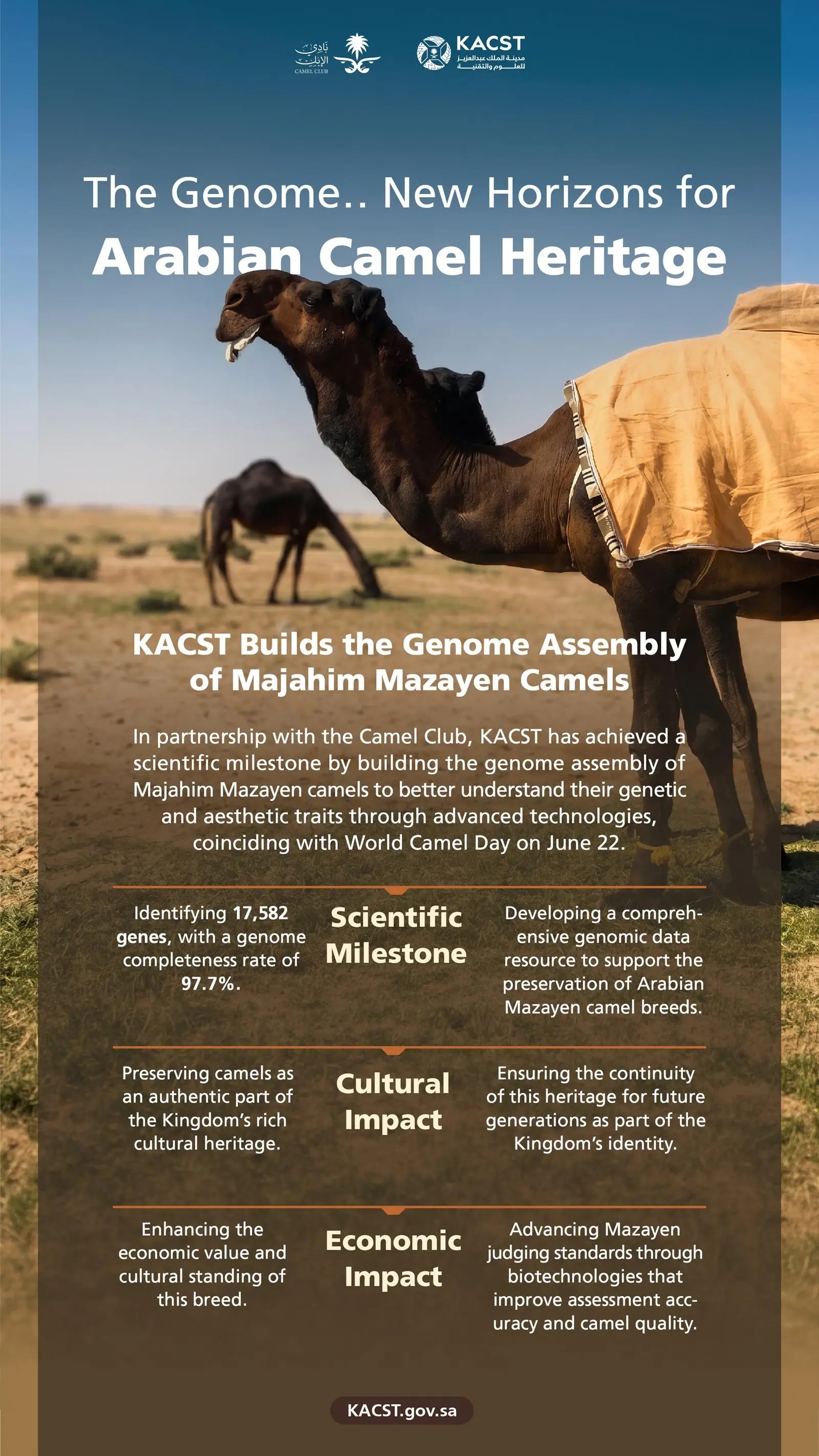
KACST Builds Genome Assembly of Majahim Mazayen Camels
King Abdulaziz City for Science and Technology (KACST), in partnership with the Camel Club, announced the successful building of the first genome assembly of the Majahim breed of Arabian Mazayen camels, marking a scientific milestone in understanding the genetic traits of this breed, which holds significant economic and cultural value in the Kingdom. The announcement coincides with World Camel Day, which falls on June 22 every year.
This achievement comes as part of the efforts of the National Laboratory at KACST to employ scientific research and advanced biotechnologies to identify and analyze the aesthetic traits of Mazayen camels as an authentic component of the Kingdom’s heritage and culture, in line with the goals of Saudi Vision 2030 to preserve this heritage and enhance its economic value.
KACST Vice President for Sustainability and Environment Sector Dr. Abdullah Alkhudhiri stated that the research team built a genome assembly for the Majahim Mazayen camel and deposited its data in the global NCBI GenBank database, enabling researchers and specialists to benefit from it in studies and research related to camels and animal genomics.
He noted that the project relied on genome reading and assembly using three advanced DNA technologies, which contributed to identifying 17,582 genes that regulate vital functions in the Mazayen camel. The project achieved a genome completeness rate of approximately 97.7%, according to international quality indicators, providing an accurate scientific reference to support specialized studies on the genetic and aesthetic traits of camels and contributing to the development of related biological applications.
Dr. Alkhudhiri also stated that this project represents an important foundational step in understanding the genetic structure of Majahim Mazayen camels by providing a high-quality genome that can be used as a reference in future studies to identify genes and genomic regions associated with the distinctive traits of this breed. He noted that this reference enables the development of a scientific base that supports future improvement and selective breeding programs, contributes to preserving desirable traits and ensuring their sustainability, and also empowers researchers to develop more precise analytical tools for understanding genetic diversity and linking genomic knowledge with important phenotypic traits in Mazayen camels.
The project enhances the economic value of the camel sector and opens new horizons for the utilization of modern biotechnologies in the development of Mazayen camel breeds, contributing to the sustainability and advancement of the sector.


