




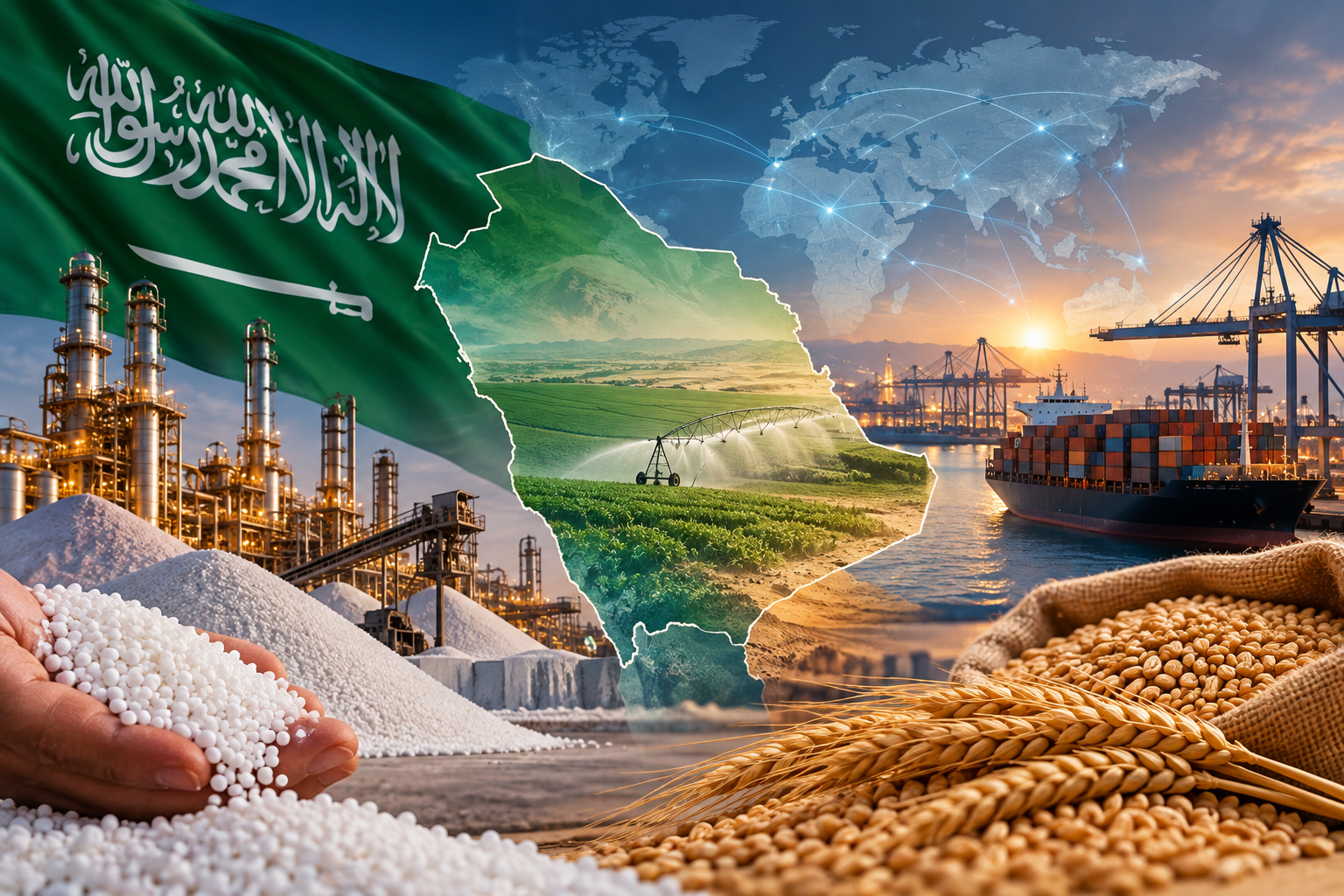
The Kingdom on Both Sides of the Shock.. Why Saudi Arabia’s food resilience depends on connecting water, global markets and supply chains
Saudi Arabia occupies a distinctive position in the global food system: it is a significant fertiliser exporter while relying on international markets for a substantial share of its cereal supplies. In 2025, the Kingdom’s fertiliser exports were valued at approximately US$6.85 billion, according to World Bank trade data. Meanwhile, the Food and Agriculture Organization (FAO) forecast Saudi Arabia’s cereal import requirements at 15 million tonnes for the 2026/27 marketing year, more than 10 per cent above the five-year average. These figures reflect different parts of the food system, but together they raise an important strategic question: how can the Kingdom manage its exposure to disruptions in global food markets while building on its strengths as a producer and exporter? The answer cannot be found in trade figures alone. Food security is shaped by the interaction of production, natural resources, international markets and the systems that move commodities from origin to destination. The challenge is not simply to secure supplies when markets are stable, but to ensure that the country can continue to meet its needs when several parts of the system come under pressure at the same time.
Such pressure rarely arrives through a single channel. Disruptions in energy markets can raise fertiliser production and transport costs. Changes in fertiliser availability can influence planting decisions and crop yields, while weather events and geopolitical tensions can affect harvests, export flows and international prices. Shipping disruption or higher freight rates can then increase landed costs or delay deliveries. For Saudi Arabia, water adds a fundamental dimension to this interconnected challenge. Domestic agricultural production must be considered alongside the Kingdom’s water constraints, making the balance between local production and international sourcing a strategic decision rather than a simple choice between self-sufficiency and imports. Producing more domestically may strengthen supply in some areas, but the benefits must be assessed against water availability and the resources required. Importing can diversify production sources and reduce pressure on domestic water resources, but it also creates exposure to global market conditions, shipping routes and the reliability of suppliers. Neither approach, considered in isolation, provides a complete measure of resilience. The objective should be to build a food system capable of managing these trade-offs while protecting reliable access to essential supplies.
This is where supply-chain resilience becomes central to national strategy. The consequences of a global shock depend not only on its size, but also on the decisions made before and during it. When to purchase, which origins to source from, how to distribute orders across suppliers, what inventory to hold and how to plan shipping and storage can all influence the cost and reliability of supply. Buying at the lowest available price, for example, may not deliver the best outcome if it creates excessive dependence on one source or leaves little flexibility when conditions change. Conversely, holding additional inventory or diversifying suppliers can improve resilience, but it also carries costs and may tie up capital. The task is not to eliminate every risk or maximise stocks without limit; it is to understand which risks matter, how they interact and which capabilities provide worthwhile protection. This requires a broader view of supply chains, connecting commodity-market intelligence, procurement, shipping, storage and demand planning rather than treating them as separate functions. It also requires decisions to be evaluated beyond the performance of an individual organisation or stage of the chain. A saving in one area may create greater costs or vulnerabilities elsewhere. My research into the relationship between commodity prices and freight markets has reinforced the importance of understanding these interactions when evaluating supply-chain decisions.
For Saudi Arabia, the opportunity is to strengthen a joined-up approach to food-system resilience: one that connects water strategy, agricultural policy, global market intelligence, procurement and logistics planning. This does not mean pursuing self-sufficiency at any cost, nor assuming that international markets will always provide supplies on favourable terms. It means understanding the Kingdom’s exposure across different scenarios and investing in capabilities that reduce that exposure in economically justified ways. Strategic reserves, diversified sourcing, reliable logistics infrastructure and better coordination between relevant stakeholders can each contribute, but their value depends on the risks they address and the costs they impose. The right question is not simply how much resilience can be built, but which combination of measures delivers the greatest reduction in risk for the resources committed. Saudi Arabia’s position as a fertiliser exporter provides an important strength in the global food system; its cereal import requirements and water constraints underline why resilience must be considered across the whole system. In a world where shocks can move rapidly from energy and agricultural inputs to commodity prices, shipping and food supplies, national resilience depends on seeing these connections early and acting on them together. The Kingdom’s advantage will come not only from its position in global markets, but from how effectively it manages the risks and opportunities linking them.

Dr. Ahmed Aljizani


