




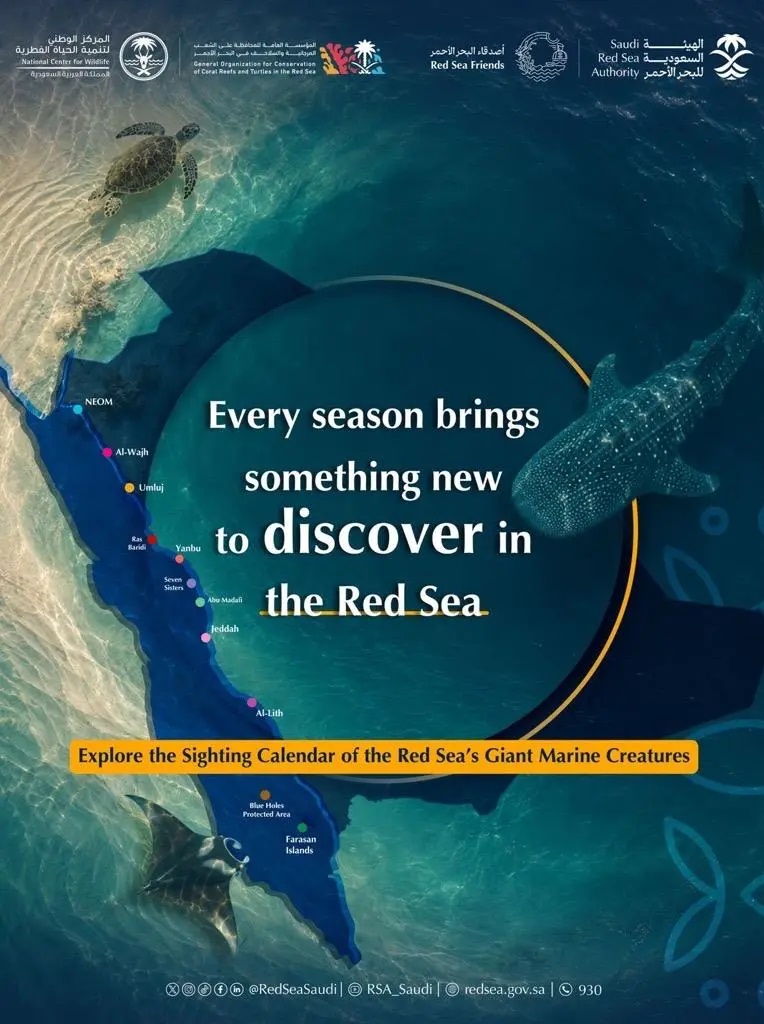
Saudi Red Sea Authority Launches Calendar of Red Sea’s Giant Marine Creatures
The Saudi Red Sea Authority (SRSA), in collaboration with the National Center for Wildlife and the General Organization for Conservation of Coral Reefs and Turtles in the Red Sea (SHAMS), and under the umbrella of Red Sea Friends, has launched the Kingdom’s first Sighting Calendar of the Red Sea’s Giant Marine Creatures.
The calendar aims to introduce the Red Sea’s giant marine creatures, encourage visitors to discover and observe them in their natural habitats, and raise awareness of responsible wildlife-viewing practices, contributing to the protection of marine species and their natural habitats.
The calendar serves as an informative guide for tourists, visitors, marine activity practitioners, wildlife enthusiasts, and marine tourism activity operators. It provides information to help them identify the Red Sea’s giant marine creatures and plan their sighting experiences according to the seasons and locations where sightings are more frequent. This contributes to enriching tourism experiences and enhancing visitors’ enjoyment of the Red Sea’s unique natural attractions.
The calendar features detailed information on the seasons and locations for sighting a range of giant marine creatures along the Saudi Red Sea coast. Dolphins can be sighted year-round in NEOM, Al-Wajh, Umluj, Ras Baridi, Yanbu, Seven Sisters, Abo Madafi, Jeddah, Al-Lith, Blue Holes Protected Area, and Farasan Islands. Sightings of Manta Rays are more frequent from April to August in Yanbu, Umluj, and Al-Lith, while Whale Sharks are more frequently observed from February to May in Al-Lith and near coastal areas in the southern Red Sea. Hammerhead Sharks are more frequently sighted during February and March in Yanbu and the southern Red Sea, including the Blue Holes Protected Area, while Bryde’s Whale is more frequently observed in August southwest and west of the Farasan Islands Protected Area.
The calendar also provides information on Glaucostegus Halavi, which can be sighted year-round in Al-Wajh, as well as Green Turtles, whose nesting season extends from April to July and whose hatchlings emerge from June to September, and Hawksbill Turtles, which can be sighted from May to July. The calendar identifies Al-Lith, Jazan, Umluj, Yanbu, Al-Wajh, Jeddah, and Ras Baridi as sighting locations for both turtle species, in addition to the Farasan Islands beaches for Hawksbill Turtles.
The launch of the calendar forms part of the Saudi Red Sea Authority’s and its partners’ efforts to enrich coastal tourism and marine tourism experiences, enhance knowledge of the marine environment, and highlight the Red Sea’s exceptional biodiversity. These efforts support the development of sustainable marine tourism products, raise awareness of the importance of protecting marine species and their natural habitats, and encourage the adoption of responsible practices when engaging in tourism and marine activities.
The calendar reflects the integration of efforts among national entities concerned with protecting the marine environment and developing sustainable coastal tourism. It contributes to enriching visitor experiences, promoting the sustainable use of natural resources, supporting marine conservation objectives, and reinforcing the Red Sea’s position as a world-class coastal and nature tourism destination.
The calendar can be accessed through the following link: https://www.redsea.gov.sa/sites/default/files/2026-11/Sighting-Calendar-of-the-Red-Sea-Giant-Marine-Creatures.pdf.


