




The Four Global Initiatives: China’s Proposal for Building a Global Community of Shared Future
Today, profound changes unseen in a century are unfolding at an accelerating pace. Global challenges, including geopolitical conflicts, imbalances in development and the ineffectiveness of global governance, are intertwined and compounding one another. The deficits in peace, development, security and governance facing the international community continue to grow.
In response to the profound question of “Where is humanity headed?”, Chinese President Xi Jinping has put forward the vision of building a global community with a shared future and proposed the Global Development Initiative, the Global Security Initiative, the Global Civilization Initiative and the Global Governance Initiative. Focusing on addressing structural North-South imbalances, disorder in the security landscape, discord among civilizations and dysfunction in global governance, these initiatives establish a systematic framework for global governance across four key dimensions—development, security, civilization and governance. They aim to promote the building of a better world and create a better life for people in all countries.
The Global Development Initiative (GDI) focuses on advancing international development cooperation, prioritizing development and adopting a people-centered approach. It aims to build international consensus on promoting development, foster new drivers of global development, accelerate the implementation of the United Nations 2030 Agenda for Sustainable Development, and promote stronger, greener and healthier global development.
The Global Security Initiative (GSI) seeks to resolve international disputes through dialogue and consultation. It advocates a vision of common, comprehensive, cooperative and sustainable security. It calls on countries to adapt to the profoundly changing international landscape in the spirit of solidarity, and address various traditional and non-traditional security risks and challenges with a win-win mindset. It aims to eliminate the root causes of international conflicts, improve global security governance, and promote durable peace and development in the world.
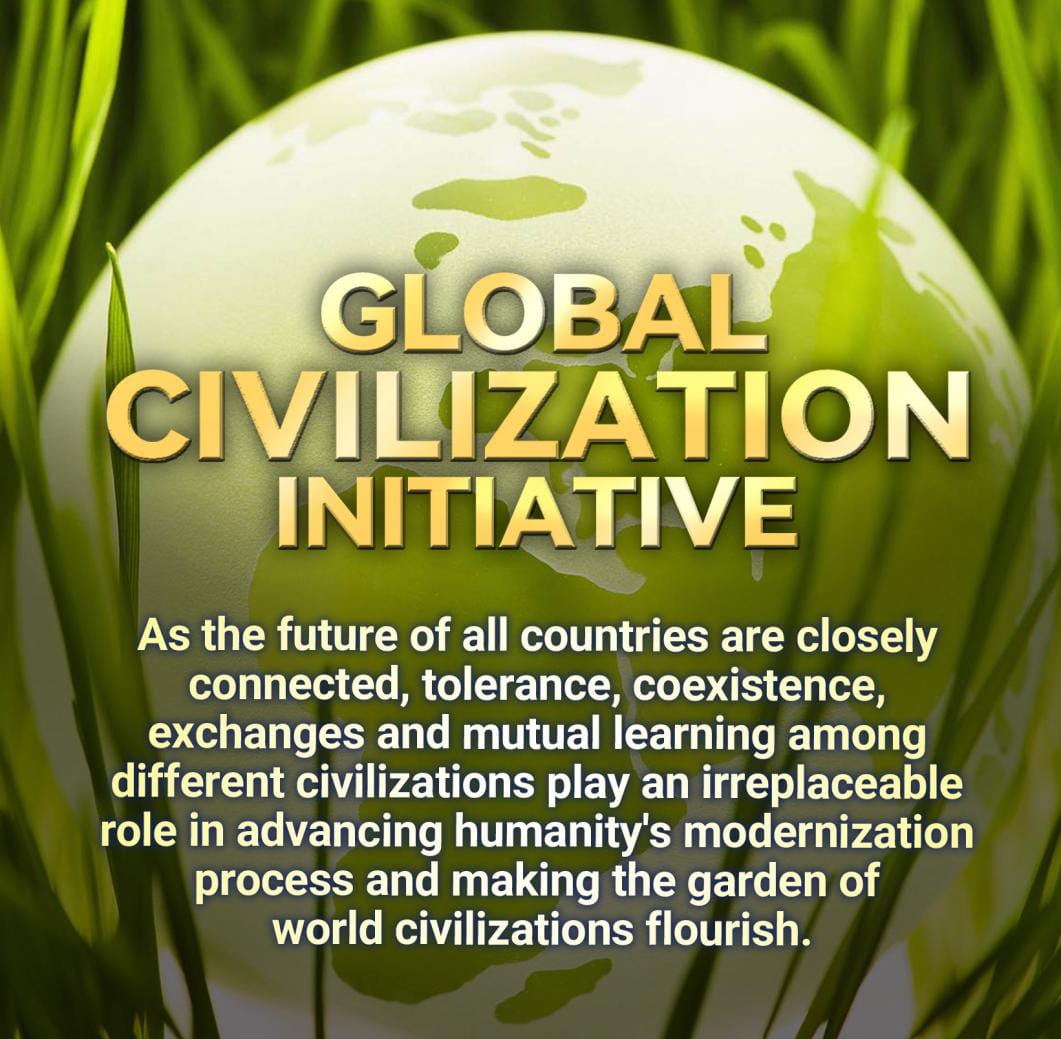
The Global Civilization Initiative (GCI) is committed to promoting exchanges and mutual learning among civilizations. It emphasizes that civilizations are neither superior nor inferior to one another, and calls for harmonious coexistence and mutual enrichment among diverse civilizations. Upholding a vision of equality, mutual learning, dialogue and inclusiveness among civilizations, it seeks to build a global garden of civilizations in which each civilization flourishes in its own unique way and all thrive together.
The Global Governance Initiative (GGI) aims to advance reform of the global governance system. Upholding the purposes and principles of the UN Charter and embracing a global governance vision characterized by extensive consultation, joint contribution, and shared benefits, it calls on all countries to work together to build a more just and equitable global governance system.
China is not only the initiator of the four global initiatives, but also an active force in advancing their implementation. Over the years, China has remained committed to an action-oriented approach, building consensus through inclusiveness and promoting implementation through cooperation. The four global initiatives have already yielded a wealth of tangible and practical outcomes, demonstrating growing vitality.
Humanity is a community with a shared future, in which all countries rise and fall together. Countries are not sailing in more than 190 small boats, but are all aboard one large ship with a shared destiny. China stands ready to work hand in hand with countries around the world, especially Saudi Arabia, to advance the implementation of the four global initiatives and build a community with a shared future for humanity. Together, we will strive for peace, pursue development, promote cooperation and uphold justice, making unremitting efforts to advance world peace, stability, prosperity and development.
Building a Global Community with a Shared Future: Outlining a New Vision for Building a Better World
In March 2013, Chinese President Xi Jinping first put forward the concept of a community with a shared future for humanity in a speech in Moscow. He pointed out that “mankind lives in the same global village, living in the same spacetime where history and reality intersect, becoming a close-knit community of shared future.” Since then, he has elaborated on this important vision on numerous important occasions.
China has raised a five-point proposal for building a global community of shared future: building partnerships in which countries treat each other as equals, engage in extensive consultation, and enhance mutual understanding; creating a security environment featuring fairness, justice, joint efforts, and shared interests; promoting open, innovative, and inclusive development that benefits all; increasing inter-civilization exchanges to promote harmony, inclusiveness, and respect for differences; and building an ecosystem that puts Mother Nature and green development first.
The overall goal of building a global community of shared future is to build a world of five goals: a world of lasting peace through dialogue and consultation; a world of common security for all through joint efforts; a world of common prosperity through win-win cooperation; an open and inclusive world through exchanges and mutual learning; and a clean and beautiful world through green and low-carbon development.
A broad consensus of solidarity and cooperation has developed in the international community behind the proposal and the implementation of the concept of a global community of shared future to address the challenges facing humanity. Against this backdrop, President Xi Jinping has given profound thought to the questions of “what kind of world to build and how to build it” and successively put forward the four global initiatives, establishing a comprehensive and systematic framework for action to advance the building of a community with a shared future for humanity in a deeper and more substantive way.
Global Development Initiative: Steering Global Development Toward a New Stage of Balanced, Coordinated and Inclusive Growth
In September 2021, Chinese President Xi Jinping put forward the Global Development Initiative (GDI) at the general debate of the 76th Session of the United Nations General Assembly. He called for staying committed to development as a priority, to a people-centered approach, to benefits for all, to innovation-driven development, to harmony between man and nature, and to results-oriented actions, with a view to jointly fostering a pattern of development that is universally beneficial and balanced, coordinated and inclusive, based on win-win cooperation, and conducive to common prosperity.
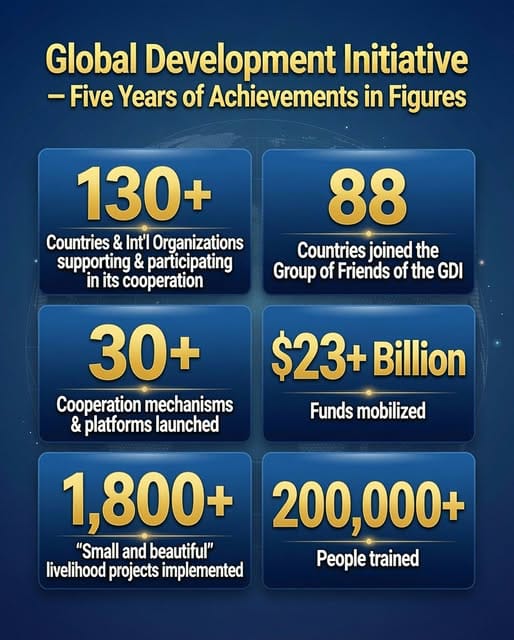
Over the past five years, the GDI has evolved from a Chinese proposal into a common international endeavor. It has strengthened the international consensus on prioritizing development, advanced mutually beneficial development cooperation, and responded to the development needs of countries in the Global South. More than 130 countries and international organizations support the Initiative and participate in cooperation under its framework, while nearly 100 countries and international and regional organizations have signed cooperation documents with China. The principle of prioritizing development has taken deeper root, and a global partnership for development is steadily gaining momentum.
Global Security Initiative: Jointly Promoting World Peace and Tranquility
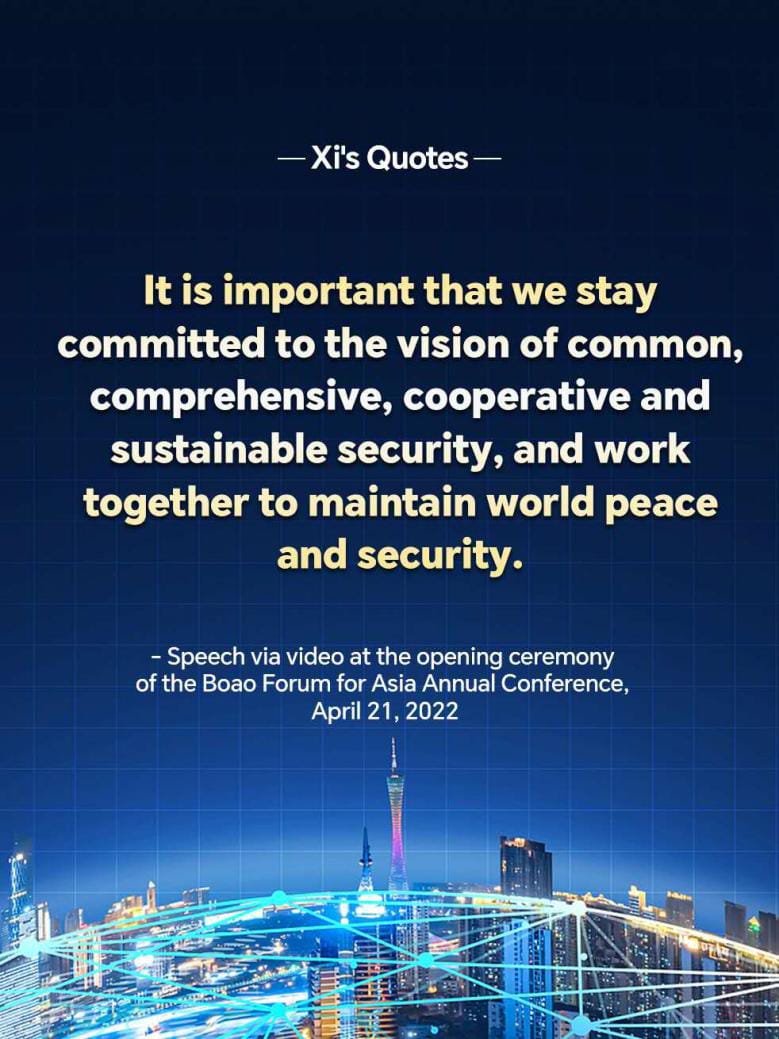
In April 2022, Chinese President Xi Jinping proposed the Global Security Initiative (GSI) at the opening ceremony of the Boao Forum for Asia Annual Conference 2022. The Initiative is underpinned by six commitments: staying committed to the vision of common, comprehensive, cooperative and sustainable security; staying committed to respecting the sovereignty and territorial integrity of all countries; staying committed to abiding by the purposes and principles of the UN Charter; staying committed to taking the legitimate security concerns of all countries seriously; staying committed to peacefully resolving differences and disputes between countries through dialogue and consultation; and staying committed to maintaining security in both traditional and non-traditional domains.
Under the framework of the GSI, China engages in bilateral and multilateral security cooperation with countries around the world, as well as international and regional organizations. It actively promotes the alignment of security visions and expands converging interests, providing practical solutions for the international community to address security issues and build security relations.
China not only remains steadfast in pursuing peaceful development, pledging never to seek hegemony, engage in expansion, or pursue spheres of influence, and firmly upholding the purposes and principles of the UN Charter, but also consistently stands on the side of peace and dialogue, fairness and justice, on many regional and international hotspot issues, while actively exploring ways to resolve them.
No matter how the international landscape may evolve, China's resolve and commitment to being a builder of world peace will remain unchanged. China will continue to work hand in hand with all countries to implement the Global Security Initiative and promote security and stability in the world and across regions.
Global Civilization Initiative: Jointly Upholding the Diversity of Human Civilizations
In March 2023, Chinese President Xi Jinping proposed the Global Civilization Initiative (GCI) at the CPC in Dialogue with World Political Parties High-Level Meeting. The initiative puts forward “four proposals”: advocating respect for the diversity of civilizations; advocating the common values of humanity; advocating the importance of inheritance and innovation of civilizations; and advocating robust international people-to-people exchanges and cooperation.
In 2024, the 78th session of the United Nations General Assembly adopted by consensus a resolution proposed by China and 82 other countries, designating June 10 as the International Day for Dialogue among Civilizations. This fully demonstrates that the Global Civilization Initiative is in keeping with the trend of the times and responds to the needs of our era, and that China’s ideas and proposals are gaining ever-wider international recognition.
Global Governance Initiative: Promoting a More Just and Equitable Global Governance System
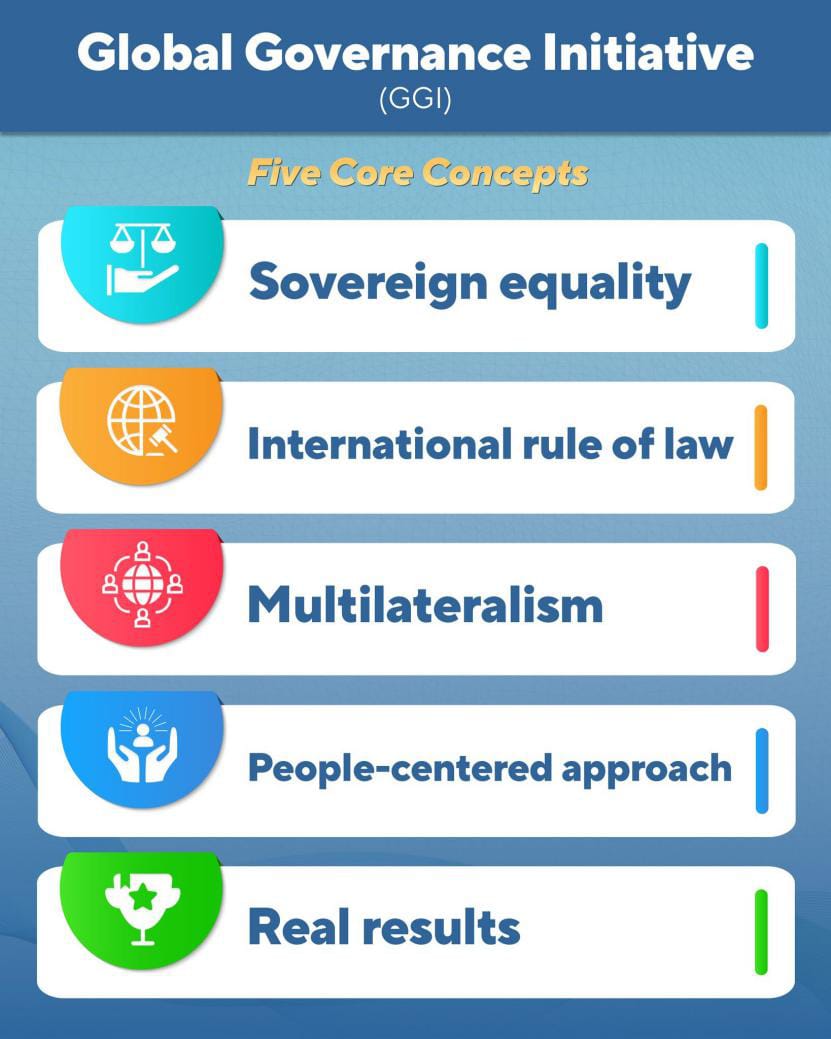
In September 2025, at a critical historical juncture marking the 80th anniversary of the founding of the United Nations, Chinese President Xi Jinping solemnly put forward the Global Governance Initiative (GGI) at the “SCO Plus” Meeting. The Initiative is built on five core concepts: sovereign equality, the international rule of law, multilateralism, a people-centered approach, and real actions.
The Global Governance Initiative is fully aligned with the purposes and principles of the UN Charter, and has quickly won the support and positive responses of nearly 160 countries and international organizations. More than 60 countries have joined the Group of Friends of Global Governance. China has also promoted the expansion of BRICS and the Shanghai Cooperation Organization (SCO), and called for reforms of institutions such as the International Monetary Fund (IMF) and the World Bank, effectively enhancing the voice of Global South countries on multilateral platforms.
The fruitful outcomes achieved by the GGI over the past year have made it abundantly clear that extensive consultation, joint contribution, and shared benefits represent the common aspiration of all, that upholding multilateralism is a shared consensus of all, and that building a more just and equitable global governance system is a common expectation of all.
A New Security Architecture for the Middle East
The security landscape in the Middle East is undergoing profound changes, with the spillover effects of regional conflicts continuing to emerge. In April 2026, during a phone conversation with HRH Mohammed bin Salman bin Abdulaziz Al Saud, Crown Prince and Prime Minister of Saudi Arabia, Chinese President Xi Jinping noted that China supports regional countries in building a common home of good-neighborliness, development, security and cooperation, holding their future in their own hands, and promoting lasting peace and security in the region.
Following his four-point proposal on maintaining and promoting peace and stability in the Middle East and his four-point principles on Palestinian question, President Xi put forward a new initiative on the situation in the Middle East in September this year. Addressing four key dimensions—unleashing the internal momentum of regional common security, advancing comprehensive governance of regional common security, cementing the foundation of regional common security, and enhancing international coordination on regional common security—the initiative supports regional countries in exploring the building of a new security architecture for the Middle East and offers a Chinese solution to the region’s security challenges.
As a good friend and partner of Middle Eastern countries, China has consistently and firmly supported their independent exploration of development paths suited to their national conditions, their efforts to safeguard sovereignty, independence and territorial integrity, and their efforts to resolve issues through dialogue and consultation. China will continue to be a builder of peace, a contributor to stability and a contributor to development in the Middle East, and play a constructive role in realizing a brighter future for the region.


