




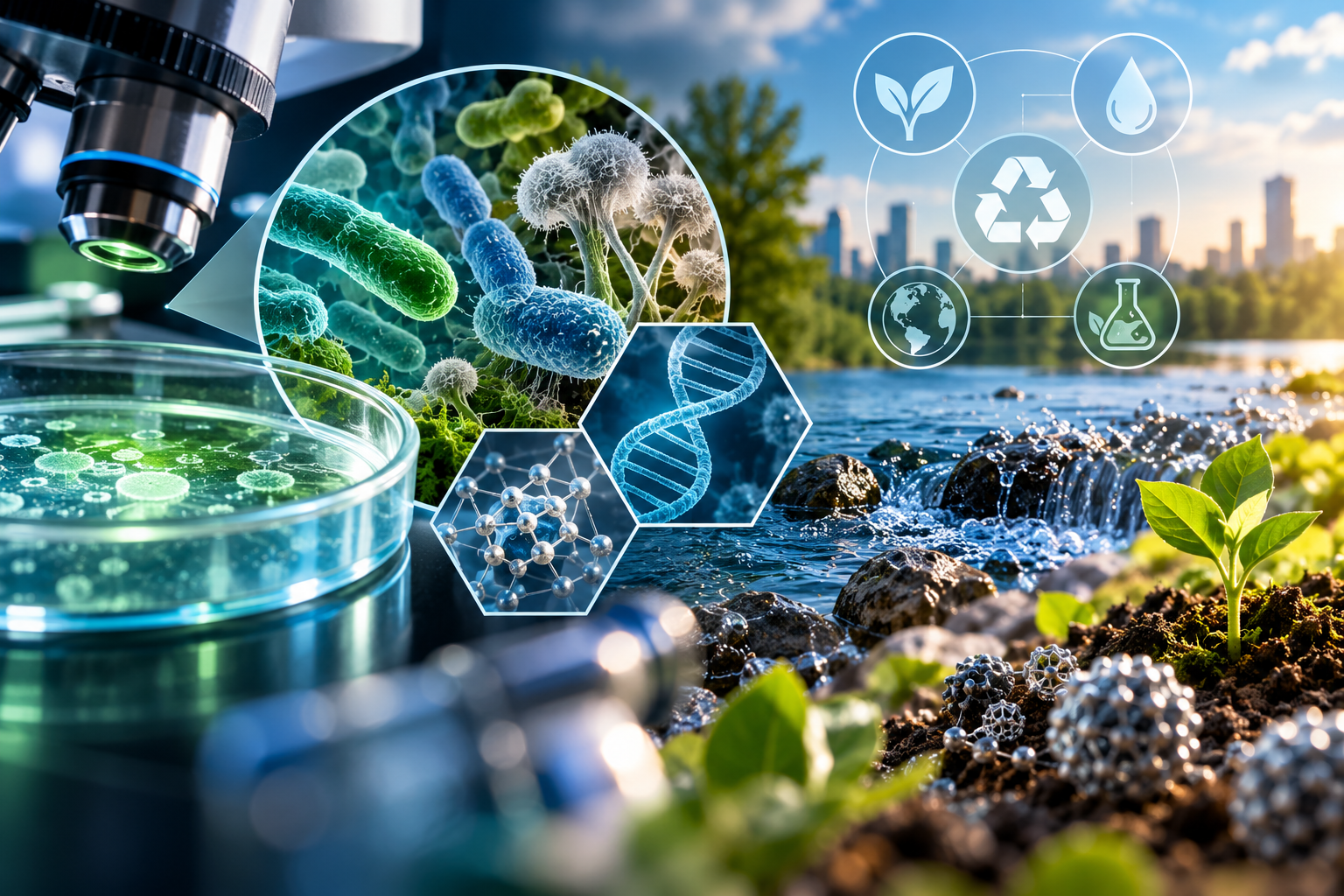
A Scientific Revolution Integrating Microbiology and Nanotechnology to Address Environmental Pollution and Promote Sustainability
In light of ongoing environmental changes and the challenges arising from rapid industrial expansion, scientific attention is increasingly directed toward modern approaches that integrate microbiology with advanced nanotechnology. This integration aims to combat pollution and accelerate the remediation of soil and water through innovative, more efficient, and sustainable methods.
Moving beyond temporary solutions that address only the surface of environmental problems, contemporary research now focuses on the microscopic network of biological and molecular interactions. At the heart of this network, microorganisms play a decisive role in maintaining environmental balance. Although invisible to the naked eye, they exert a profound influence on pollutant degradation, water purification, and the long-term sustainability of natural ecosystems.
This scientific direction highlights the value of integration among microbiology, biotechnology, and nanotechnology. Certain bacterial genera, such as Pseudomonas and Bacillus, as well as fungal genera such as Aspergillus and Trichoderma, are capable of producing highly active enzymes that contribute to the degradation of complex organic compounds, plant residues, and industrial waste.
With the advancement of modern genetic sequencing platforms, including Illumina and Oxford Nanopore technologies, researchers are now able to read the genetic fingerprints of microbial communities directly from environmental samples. This enables a more accurate prediction of bioremediation efficiency and microbial responses to pollutants and environmental risks, rather than relying solely on conventional observation-based approaches.
Nanotechnology has added a new dimension to environmental remediation. Nanoparticles are distinguished by their large surface area and high reactivity, which enhance the breakdown of complex compounds and the adsorption of heavy metals. When these properties are combined with microbial enzymes and living microorganisms, they form what is known as “nano-bioremediation,” an advanced approach that strengthens environmental intelligence in waste recycling and the conversion of waste into useful resources, such as bioenergy and biofertilizers. This reflects the broader concept of the circular bioeconomy.
Modern applications are also evident in wastewater treatment and in the early detection of complex pollutants, such as highly persistent chemicals known as PFAS and microplastics. These applications increasingly rely on precise monitoring tools, including biosensors and CRISPR-based technologies, which allow rapid detection of antimicrobial resistance genes and other environmental risk indicators.
Experts and researchers emphasize that the future of pollution remediation will not depend solely on conventional mechanical and chemical solutions. Rather, it will rely on more efficient bioreactors, safer nanomaterials, and early-warning sensing systems. Despite these promising prospects, scientists stress the importance of careful and responsible application. It is essential to verify toxicity reduction and the full restoration of environmental quality in order to prevent unintended ecological consequences.
This integrative scientific revolution forms a bridge between the laboratory and the real environment. It opens the way toward a safer and more sustainable future, one that depends on environmental intelligence and scientifically grounded solutions that can be applied effectively on a broader scale.
* Prof. Dr. Aisha bint Mohammed bin Hamood Al-Rajhi
Environmental Microbiology and Biotechnology
Department of Biology, College of Science
Princess Nourah bint Abdulrahman University


